

The Impact of Venous Foot Ulcers on My Daily Life
(9m read)
Introduction
Venous foot ulcers are a chronic and debilitating condition that affect thousands of people across the United Kingdom and the World. They are not just wounds that refuse to heal; they are a lifelong burden that impacts mobility, independence, employment, and the overall Quality of Life. For me, this has been an enduring reality for roughly the past twenty years. Over that time, I have lost count of how many ulcers I have had on both ankles, how many days of pain I have endured, and how many hospital and health centre visits I have made. Yet the physical wounds are only one part of the picture—the emotional, social, and financial scars are just as deep.
The following explores in depth how venous foot ulcers affect my everyday life. I will share my own journey, from the first sore that appeared decades ago, to the countless battles with pain and healing that followed. I will also reflect on the burden of medical care, the impact on my work and finances, the strain on daily routines such as cooking and shopping, and the broader question of whether venous ulcers should be recognised as a disability for benefit purposes such as Personal Independence Payment (PIP). My hope is to provide a clear and honest picture of the toll this condition takes, and why it deserves far greater recognition than it currently receives.
The Impact of Venous Foot Ulcers on My Daily Life
My experience with venous ulcers began roughly twenty years ago. When I was at school, I was on the way to a Geography exam and I slipped on black ice, a route that I should not have taken due to the weather, but thought it would be ok and avoid any ice. The first car ignored me (I knew him) and left me on the cold ground. A second car came and that person stopped thankfully. She could have manoeuvred her car a little closer to me but hey ho. She drove me back home and my mum came out. The lady wanted to get to work and I tried moving into another car (my dad was at work), but I just couldn’t move. So she had to drive me to hospital. I have no idea what happened after that. All I know is that there was a cute nurse who came to me now and again. Anyway, I fractured my right tibia and it took 6 weeks to heal. Some time later, I developed varicose veins in that leg, it then moved to my left.
Now, moving forwards to when I began working from 2003, I remember waking one morning with a perfectly round sore on my ankle. I didn’t know what it was and after it didn’t heal after some days, I booked an appointment with my family GP, who examined it and told me that it was an ulcer. That was the start of a long journey. While being treated, I was offered by my GP to have some tests done to find out why I got an ulcer this included blood tests, testosterone levels, and various other checks—but nothing unusual was ever found. I found out that it was a venous ulcer some time later.
Over the years, I have developed more ulcers than I can even count. Some have healed after months of care, only for another one to open up on top of the scar months later. Others have lingered stubbornly, refusing to close after 3 months. Each and every single ulcer has been agony. I have even cried whilst at work because of them because I was so sick of them. Whilst at a hospital visit in their vascular department, I saw shapes and nearly passed out because of the pain and having them open to the air.
Living with this cycle has been exhausting, both physically and mentally.
Everyday life becomes shaped by ulcers. What many people take for granted—standing in line at a pharmacy, standing at the cooker, or even simply resting—becomes a calculation of how much pain I can endure. Swelling, throbbing, aching, and sometimes intense sharp pain are a constant reminder that my legs will never allow me to live life as I once did before I fractured my tibia.
The Burden of Medical Care
Treatment has been a continuous part of my life since that first ulcer appeared. Dressings, compression bandages, and regular hospital and health centre appointments have been essential to keeping my condition under control. Over the years, I have spent countless hours sitting in waiting rooms or travelling to and from appointments.
One burden that is rarely spoken about, but which has weighed heavily on me, is the financial cost of hospital visits. Parking charges have drained a huge amount of money over the years. A simple dressing change may only last 15 to 30 minutes, but the cost of parking quickly adds up when you attend week after week. Sometimes it’s twice a week and that dramatically increases the cost of parking. To keep this manageable, I’ve had to buy parking permits, but only if I knew I would be at the hospital for a long time. I haven’t got one in years. I pay via the ticket machine every time.
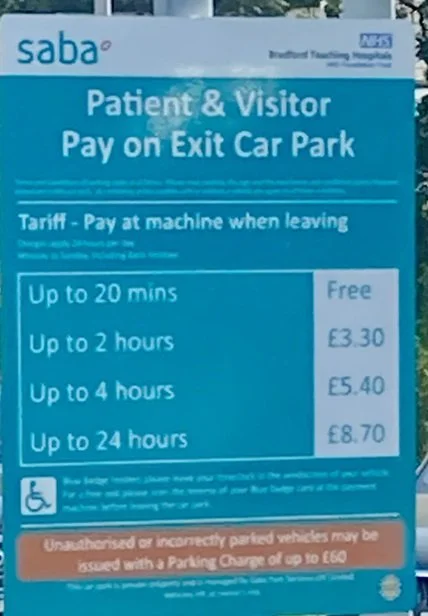
In April 2026, Bradford Teaching Hospitals decided to put the car park charges up by 80p to pay for the barriers they put in (I think this year). This may not sound much to you, but it’s a ridiculous amount of money that the thieving dirtbags are taking from us. I complained on their Facebook page as did a load of other people. I actually sent an email complaining about the car park charges last year being too expensive especially when some people are only in the hospital for only 30 minutes. That was £2.50 back then. But yet we have to put the full £3.30 for up to two hours. I received a reply just to say that they’ll review it at their next meeting - Didn’t work did it 😡
The financial toll of simply accessing treatment is something that people without chronic conditions rarely have to think about. And they SHOULD.
Despite these difficulties, I must say that my healthcare has been very good. I have received strong support from compassionate nurses especially at one hospital, who understand the long-term struggle I face. We have laugh and talk together. Their care, consistency, and kindness have been invaluable to me. I have no complaints about the quality of treatment I have received; without it, I doubt I would have been able to manage this condition at all.
I’m with a Facebook group and I can’t help wondering how those in the USA cope without seeing a healthcare professional when they manage their wounds themselves.
Recently my local leg ulcer clinic at a health centre has refused to treat ulcers that are below the ankle all because one nurse said something. I wasn’t happy. But good riddance to them because the hospital is better. My local podiatry at the same health centre are not able to offer good health care due to them not being able to put compression bandages on. This time filled the silly online form in and asked to be referred to a hospital, which has been granted.
Impact on Work and Finances
One of the most significant consequences of venous ulcers has been their effect on my working life. At first, I tried to push through the pain and keep working, but the condition became increasingly difficult to manage. Unlike many illnesses, venous ulcers are not always visible. One employer didn’t believe I had a genuine health problem. I felt as thought I was treated cruelly by that company, who demanded hospital letters and insisted on seeing my records to “prove” I had a problem. This lack of trust made me feel humiliated and unsupported.
Also as I’m sitting here, I’d better mention that they thought I was lying about having conjunctivitus. I’ve never had it before, but there was one time when I was having trouble focussing on far away things. The next morning I couldn’t see properly and had to see a doctor, ringing my workplace to say I couldn’t go in.
There was also another time when I had an ulcer, and I told them first thing in the morning that I had a doctors appointment later in the day. They refused to let me go. When the time came, I walked out and attended my appointment - My health is worth more than my job! They weren’t happy when I went back to work the next day. Did I care? Did I Hell !!!
Sitting, thankfully, is one of the few positions that offers some relief, as it reduces pressure on my veins and eases the pain especially when I have my foot propped up on a buffet or under my PC desk. However, many jobs require standing or moving for long periods, and that is simply impossible during flare-ups. Over time, I have not been able to sustain a working life due to being made redundant twice (not because of ulcers, but because no one wants to employ me). At 10 years working for the same company, I was made redundant because I was sitting down for half the day. Instead of getting rid of me, they should have offered to put me on sick leave with reduced pay, but they let me go instead. One manager didn’t like me and I didn’t like her as I’ve had arguments with her in the past. They just HAD to find a reason to get rid of me. Wish I sued them.
Less than one year later, I was resting in front of my PC, and suddenly a wave of tingling came down one side of my face. It went away in a minute or so. I went to see a GP about it and they sent me off for a scan of my head. The results proved nothing. I asked the consultant if it might be caused my anxiety losing my job. He said yes. So I have always put it down to having anxiety, but I’m unsure now. I have good days and bad with the tingling just above my eyes, or on my forehead.
Financially, this has become a devastating impact on money. I have lost a tremendous amount of income over the years not working. Knowing that I have been unable to work most of my life because of this condition has been a constant worry. Money has become an increasing problem, and I live with the fear of not being able to cover basic costs. I worry about losing my car, which is essential for getting to appointments, getting out of the house and doing what I love - photography, fishing and walking and creating videos. In darker moments, I have even worried about ending up on the streets if my father was no longer here.
I once had a job interview and told the employer that I had a problem. They got back to me some days later and said they wouldn’t hire me because of ‘health and safety’. Some rubbish they made up. Now, I don’t mention it to any employer in fear they won’t hire me. About a year later I applied for the same job and a recruitment agency got back to me and asked if I was interested. I said yes, but the employer wouldn’t want me because of my problem. They said they would ask but I replied saying not to bother.
These are not just passing concerns—they are real anxieties that come from years of lost earnings and mounting costs.
Impact on Daily Routines
Venous ulcers interfere with the most ordinary parts of daily life. Something as simple as preparing a meal can become exhausting when my father isn’t at home. Standing at the cooker for less than five minutes can lead to throbbing pain, so I often have to sit down and rest in between cooking tasks even when something is on the cooker.
Going shopping, for example, may involve limping painfully down aisles, struggling to carry bags because standing makes the swelling worse, and returning home exhausted walking up a flight of steps to the house. Carrying shopping baskets or bags is especially difficult because the weight puts direct pressure on my legs and causes pain in my ulcers. Tasks that most people see as routine are, for me, major physical challenges.
Life with venous ulcers is a constant negotiation between what needs to be done and how much my legs will allow me to do.
Venous Ulcers and Disability Recognition
One of the most frustrating realities of living with venous ulcers is that they are not widely recognised as a disability. This has a major impact on access to benefits and support, particularly through Personal Independence Payment (PIP).
The current system often judges disability based on whether someone can perform certain tasks, such as cooking, shopping, or cleaning. On paper, I may be able to do these tasks—but what the system does not account for is the pain, exhaustion, and lasting effects that come with them. Yes, I can prepare a meal, but it will leave me in pain and needing to rest whilst cooking a meal. Yes, I can go shopping, but it involves limping painfully, carrying bags that worsen the ulcers, and returning home drained. Yes, I can keep up with chores, but every action worsens the swelling in my legs.
Just because I am technically able to carry out these tasks does not mean I am not disabled by the process of doing them. Venous ulcers restrict my independence, my comfort, my ability to sustain employment, and my financial stability. This should be recognised in the same way as other long-term disabling conditions.
I strongly believe venous foot ulcers should qualify as a recognised disability under PIP. The fact that they are invisible to others makes it easy for decision-makers to underestimate their impact. But for those of us who live with them, they are nothing short of life-changing.
Equality Act 2010 and Venous Ulcers
The Equality Act 2010 protects individuals in the UK from discrimination arising from a disability. A condition is considered a disability if it has a substantial and long-term effect on a person’s ability to carry out normal day-to-day activities.
For individuals living with venous leg or foot ulcers, the impact can often be significant. These ulcers may cause ongoing pain, swelling, difficulty standing, or reduced mobility. Because these have a long-tern effect on myself, the condition should meet the legal definition of a disability under the Equality Act 2010.
Employers’ Duty: Reasonable Adjustments
Employers are legally required to make reasonable adjustments so that employees with disabilities are not placed at a disadvantage in the workplace. For those managing venous ulcers, such adjustments may include:
Providing a chair or footrest – enabling the individual to elevate their legs during the working day to reduce swelling, improve circulation, and manage discomfort
Allowing regular breaks – giving time to rest, relieve pain, or adjust dressings if required
Flexible or home-based working – reducing the strain of commuting and offering greater comfort while maintaining productivity
Workstation adaptations – such as ergonomic seating or an adjustable desk to improve comfort and posture
Adjusting duties where necessary – modifying physically demanding tasks while enabling the employee to contribute fully in other ways
Why This Matters
Applying the Equality Act in practice benefits both employees and employers. By making small but meaningful adjustments, employers can:
Support employee wellbeing and reduce sickness absence
Retain valuable skills and experience within the workforce
Foster a culture of inclusivity and fairness
Meet their legal obligations and avoid potential claims of discrimination
In summary, individuals with venous ulcers should not be excluded from the workplace. With the right support and reasonable adjustments, they can continue to work productively while managing their health condition effectively.
Conclusion
Living with venous foot ulcers has been an exhausting and often overwhelming journey, one that has shaped every part of my life for twenty years. Those years are still counting upwards. The physical pain, the countless treatments, the financial burden, and the emotional strain of being doubted by employers and overlooked by the benefits system have all taken their toll. While I have adapted to survive, the truth is that this condition is far more than a minor inconvenience—it is a life-altering, chronic disability.
There is a pressing need for greater recognition of venous ulcers in society and within government systems such as Personal Independence Payment. Even if someone is technically able to complete daily chores, shop, or prepare food, the fact that these activities are performed in severe pain should qualify as a disability. Disabilities are not only about what one can or cannot physically do, but also about the level of suffering and limitation that comes with completing those tasks.
Beyond medical treatment, there should also be more structured support for people living with venous foot ulcers across the UK. At present, there are very few dedicated support groups where individuals can share their experiences, coping strategies, and emotional struggles. A nationwide network of support groups—whether in hospitals, community centres, or online—would give sufferers the chance to feel less isolated, learn from others facing similar challenges, and gain encouragement during the long and often frustrating healing process. Knowing that there are others who truly understand what it is like to live with chronic ulcers could make a significant difference to mental wellbeing and resilience.
Employers, too, must be more understanding. Rather than doubting or mistreating those who live with ulcers, they should seek ways to support them. Simple measures can make a tremendous difference—for example, allowing staff rest breaks and providing somewhere to elevate their legs. Keeping the legs level with the hips reduces swelling and pain, and can enable someone with ulcers to work more comfortably and productively. People with venous ulcers want to work and contribute, but they need the compassion and flexibility of employers to make it possible.
Ultimately, my story is not just about me, but about many others who face the same hidden battle. Recognition, understanding, and practical support are essential to improving the quality of life for those who live with venous foot ulcers. Until society, healthcare, and workplaces take this condition seriously, people like me will continue to suffer unnecessarily—despite our determination to carry on.
— David